
 Business License

Advances in Electrode Coating Technology for Chlorine Generation: Longer Life, Lower Overpotential
An electrochlorination plant in the Middle East was drawing 4.9 kWh per kilogram of chlorine when its cells were new. Five years later, the same cells were drawing 5.8 kWh — a voltage creep driven entirely by a worn mixed metal oxide coating on the anodes. The extra energy alone cost the operator roughly $28,000 per year, and the replacement anode sets were the largest single line item in the maintenance budget.
Electrode coatings rarely appear in sales brochures, yet they govern three numbers that matter to every plant owner: energy consumption, anode service life, and maximum chlorine output. Advances in coating composition and structure over the past decade have quietly shifted all three in the operator's favor, and the technology continues to move.
1. Why the Electrode Is the Economic Heart of the System
The anode is where chlorine is born. Chloride ions surrender electrons at its surface, and the rate and efficiency of that reaction set the plant's productivity. A coating that lowers the energy barrier — the overpotential — directly reduces the kilowatt-hours consumed per kilogram of chlorine, which is the largest recurring cost in brine electrolysis technology after salt.
The anode is also the component with the shortest life in most systems. A mixed metal oxide (MMO) coating on a titanium substrate typically survives 5 to 8 years in seawater or brine service before the noble metal loading is depleted to the point of failure. Because anodes are expensive — often 10% to 20% of the electrolyzer's total cost — every additional year of service life is a direct saving.
In short, the electrode determines the two biggest numbers on the operating ledger: energy per kilogram and replacement interval. That is why coating chemistry, not cell geometry, is where most of the recent gains in chlorine generation technology have come from.
2. The MMO Coating Baseline: How It Works
Modern chlorine anodes begin with a titanium substrate — chosen for its corrosion resistance and cost — coated with a thin layer of mixed metal oxides. The active components are noble metal oxides, principally ruthenium dioxide (RuO₂) and iridium dioxide (IrO₂), which catalyze the chlorine evolution reaction. Titanium dioxide in the coating acts as a stabilizer, and small additions of tin, tantalum, or antimony oxides adjust conductivity and adhesion.
The coating is applied as a liquid precursor and fired in several thermal decomposition cycles, building up a film typically 5 to 20 micrometers thick. Noble metal loading is quoted in grams per square meter — standard chlorine service uses 12 to 15 g/m², while premium coatings reach 18 to 22 g/m² — and this number correlates directly with achievable service life.
The catalyst works by providing a low-energy pathway for the reaction: chloride ions adsorb on the oxide surface, transfer electrons, and desorb as chlorine. A good coating maximizes active surface area and minimizes the voltage wasted on competing reactions, particularly oxygen evolution, which is the main efficiency thief at high current density.
3. Overpotential: The Hidden Tax on Every Cell
Overpotential is the extra voltage above the theoretical minimum that a cell needs to drive a reaction at a useful rate. For chlorine evolution, the theoretical decomposition voltage is roughly 2.2 V, but real cells run at 2.8 to 3.5 V. The difference — 0.6 to 1.3 V — is split among the anode overpotential, the cathode overpotential, ohmic losses in the electrolyte, and contact resistance.
Every 0.1 V of avoidable anode overpotential on a plant producing 200 kg/day of chlorine translates to roughly 15,000 to 20,000 kWh of wasted electricity per year, depending on cell efficiency. Over a decade, that is enough to pay for a complete set of premium anodes. This arithmetic explains why coating suppliers invest heavily in reducing overpotential rather than chasing marginal gains elsewhere.
The competing reaction — oxygen evolution — is the main source of anode overpotential in chlorine service. A selective coating channels current into chlorine production and suppresses oxygen, improving both voltage and chlorine purity. Modern ruthenium-iridium formulations with balanced ratios achieve chlorine current efficiencies of 92% to 97% in well-controlled brine electrolysis technology systems.
4. How Coating Composition Has Evolved
The earliest dimensionally stable anodes of the 1960s were pure ruthenium dioxide on titanium, revolutionary for their time but limited in life. Iridium was added in later decades because it resists oxygen evolution far better than ruthenium, protecting the coating from the very reaction it is trying to suppress. The ruthenium-to-iridium ratio became the key tuning parameter.
| Coating generation | Typical composition | Characteristic life (brine service) |
|---|---|---|
| Early DSA (1960s–70s) | RuO₂ dominant | 2–4 years |
| Ru–Ir mixed oxide | RuO₂–IrO₂ with TiO₂ stabilizer | 5–6 years |
| Modern Ru–Ir–Sn/Ta | Ru–Ir + SnO₂/Ta₂O₅ additives | 6–8 years |
| Nanostructured premium | High Ir loading, porous nano-architecture | 8–10 years |
Tin oxide and tantalum oxide additions serve specific roles: tin stabilizes the active phase and reduces ruthenium dissolution, while tantalum improves adhesion and corrosion resistance in aggressive electrolyte. The result is a coating that wears more uniformly, which matters because localized coating loss is what kills anodes early.
5. Degradation Mechanisms: What Actually Kills a Coating
Coating failure is not a single event but a slow process driven by several mechanisms. Noble metal dissolution is the fundamental one: ruthenium and iridium dissolve gradually into the electrolyte, and the coating thins until the underlying titanium passivates. When the titanium surface oxidizes, cell voltage jumps sharply, and the anode is effectively finished.
Mechanical wear accelerates the chemistry. Gas bubbles forming and detaching at the surface physically erode the coating, an effect that scales with current density. Scale deposits from hard water block active sites and create localized current concentration, which accelerates dissolution exactly where the coating is needed most. Abrasive particles in poorly filtered feed water add a third, purely mechanical, attack vector.
Operators can protect coatings through disciplined water quality control, staying within rated current density, and periodic acid cleaning to remove scale. In our experience, these habits extend anode life by 20% to 40% compared with plants that run the cell hard and clean rarely.
Startup and shutdown behavior also matters more than most operators realize. Repeated rapid current ramps stress the coating through thermal cycling, and running the cell at very low current for long periods can let scale and organic films accumulate in crevices where they are hard to remove. A simple operating rule — ramp current gradually, and avoid extended idle operation with brine in the cell — protects the coating at no cost.
6. Recent Advances: Nanostructure and High-Loading Coatings
The most meaningful recent progress is structural rather than compositional. Coatings are now engineered at the nanometer scale to maximize electrochemically active surface area. A porous, cracked-mud morphology — where the coating surface is covered in fine fissures and islands — exposes far more catalyst per square meter than a dense film, lowering the real current density at the catalyst surface.
Higher noble metal loading works in tandem. Moving from 12 to 15 g/m² up to 18 to 22 g/m² roughly doubles the active catalyst inventory, and when combined with a porous structure, extends service life toward 8 to 10 years in brine service. The extra cost of the loading is modest relative to the value of the additional years of production.
Another advance is in the barrier layer between substrate and catalyst. A thin interlayer of tantalum or titanium suboxide prevents oxygen from reaching the titanium surface and passivating it, which is the terminal failure mode of an old anode. This single change has improved end-of-life behavior dramatically, with voltage creep staying flat until coating exhaustion instead of spiking early.
7. What the Numbers Look Like in Practice
The measurable benefits of modern coatings show up clearly in plant data. Compared with standard RuO₂-dominant coatings of two decades ago, a modern Ru–Ir–Sn formulation typically reduces anode overpotential by 0.1 to 0.2 V, which at 200 kg/day output is worth roughly 30,000 to 40,000 kWh per year. Service life improves from 3 to 4 years to 6 to 8 years at similar current density.
Energy consumption per kilogram of chlorine follows the overpotential curve. A plant drawing 4.5 kWh/kg with new premium anodes may still be drawing 4.8 kWh/kg after four years, whereas a standard-coating plant commonly degrades from 4.5 to 5.3 kWh/kg in the same period. The difference compounds over the anode's life and is easily undercounted in project economics.
Current density capability has also widened. Premium nanostructured coatings tolerate 3,000 to 4,000 A/m² in seawater service without catastrophic wear, versus a practical ceiling of about 2,500 A/m² for older coatings. This lets operators install smaller cells for the same output, reducing both capital and footprint.
The trend points toward further gains rather than diminishing returns. Research into iridium-free alternatives and oxide composite systems continues, though ruthenium–iridium chemistry remains the practical standard for chlorine service. What operators can count on today is a measurable gap between commodity anodes and premium-coated ones, and that gap is worth quantifying in any plant's energy and maintenance model.
8. Case Studies
A chlor-alkali producer in Southeast Asia switched from a conventional RuO₂ coating to a high-loading Ru–Ir–Ta formulation on its membrane cell anodes. A while back, the plant documented a cell voltage reduction of roughly 0.15 V and an extension of anode replacement intervals from 5 to 7 years. Over the first full cycle, the documented savings reached an estimated $120,000 in combined energy and anode costs. The plant also reported that chlorine purity held steady during the transition, and the production team needed no additional training to operate the upgraded cells.
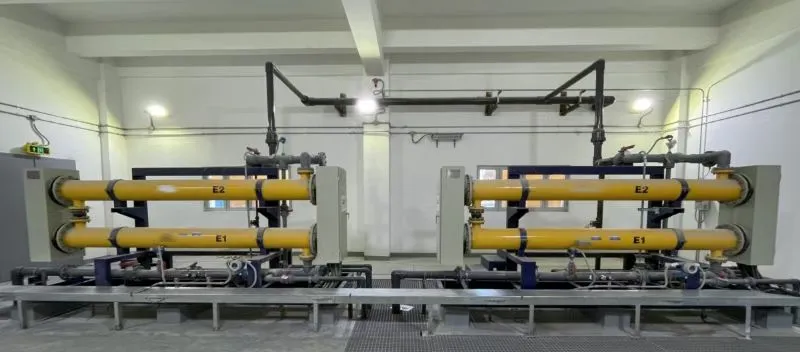
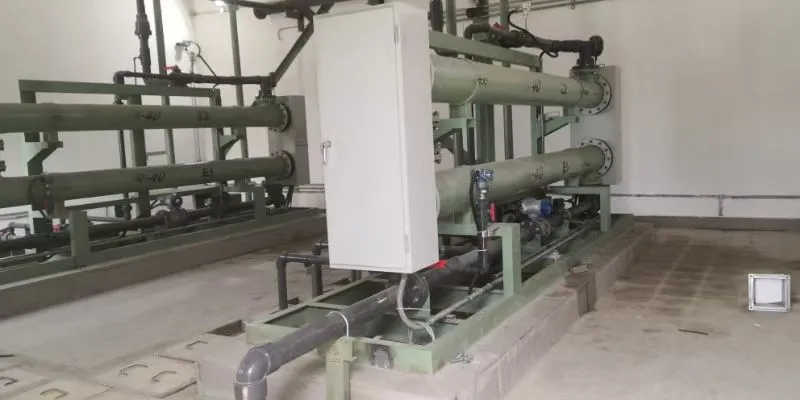
An electrochlorination system at a coastal power plant, supplied by Tianjin Bluewav Technology with premium nanostructured anodes, maintained specific energy below 4.7 kWh/kg through four years of seawater service. Cell voltage creep stayed under 5% over the period, and the first inspection found the coating in good condition with no signs of localized loss.
9. What to Look for When Specifying Anodes
Buyers should ask four questions before accepting an anode quotation. What is the noble metal loading in grams per square meter? What current density and service life are the claims based on — accelerated testing or field data? What is the stated end-of-life criterion, such as voltage rise of 10% to 15% above baseline?
A fourth question is what a replacement set costs, confirmed in writing at the time of the original quotation. Surprise spare part pricing is one of the most common complaints we hear from plant owners, and it is entirely avoidable with a written price list up front.
It is also worth asking about the substrate. Titanium grade and surface preparation matter: a roughened or etched substrate bonds the coating far better than a smooth one, and grade 1 or grade 2 titanium is standard for chlorine service. Vendors who are vague about substrate and coating details usually have less engineering behind their product.
We recommend specifying anodes by performance criteria — minimum service life, maximum voltage creep, and current density capability — rather than by price alone. Tianjin Bluewav Technology Co.,ltd quotes its anodes on this performance basis, and we find that operators who buy this way get better life-cycle economics than those who buy on unit price.
10. Frequently Asked Questions
10.1 What is the difference between overpotential and cell voltage?
Cell voltage is the total voltage applied across the cell, which includes the theoretical decomposition voltage, anode and cathode overpotentials, electrolyte resistance, and contact losses. Overpotential is specifically the extra voltage above the theoretical minimum required to drive the electrode reaction at a practical rate. A lower anode overpotential means less energy is wasted, which is why coating improvements focus on reducing it. In practical terms, a plant running at 3.0 V cell voltage with 2.2 V theoretical minimum is losing roughly 0.8 V to losses, and the anode typically accounts for a significant share of that loss in chlorine service.
10.2 How do I know when an anode needs replacement?
The standard indicators are cell voltage and chlorine efficiency. A gradual voltage rise of 5% to 8% over years is normal coating wear; a rise of 10% to 15% above baseline, or a sudden jump of 15% or more, signals coating exhaustion or localized failure. Tracking cell voltage trend — not just absolute value — gives the earliest warning, and monitoring chlorine production per kWh confirms the diagnosis. When the voltage rises but chlorine output holds, the coating is degrading; when both move together, the change may be in the brine system or rectifier instead, so check those before ordering new electrodes.
10.3 Do premium anodes really justify their higher price?
In most chlorine generation applications, yes. The premium typically adds 20% to 40% to anode cost while extending service life by 30% to 50% and lowering energy consumption. On a 200 kg/day plant, the energy saving alone usually covers the price difference within two to three years, and the extended replacement interval compounds the benefit. For plants that run continuously, premium anodes are the rational choice.
Intermittent-duty plants with modest annual operating hours may find standard coatings adequate, since the coating wears primarily during electrolysis rather than during idle periods.
10.4 Can an old electrolyzer be upgraded with new coating technology?
Yes, in most cases. Anodes are replaceable components, and fitting premium nanostructured anodes into an existing cell frame is a common upgrade path that improves energy efficiency and extends the next replacement interval. The cell body, seals, and current distribution should be inspected at the same time, because worn current distributors can cancel the benefit of better anodes. It is also worth confirming the rectifier can deliver the current the new anodes are rated for, since higher current density capability only pays off if the power supply can actually support it.
Recently Posted
-
Power Plant Cooling Water Biofouling Control: How Electrochlorination Replaces Chlorine Gas
September 4, 2026An aging coal-fired plant on the Atlantic coast of South America had relied on chlorine gas dosing for cooling water treatment sin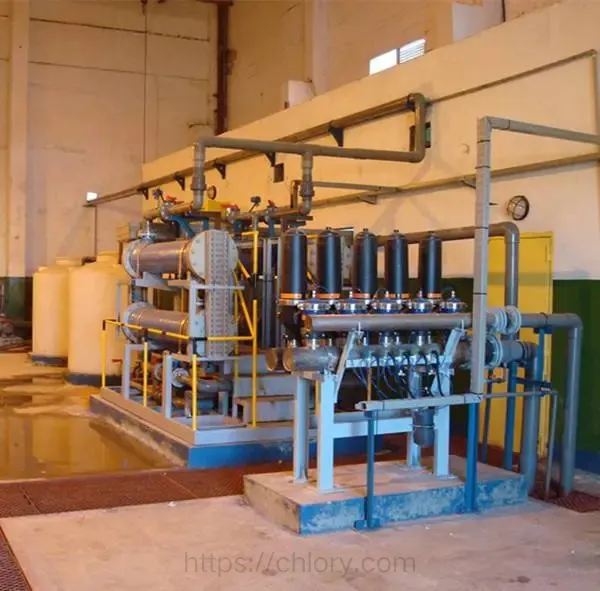 Read More
 -
How to Select a Sodium Hypochlorite Generator: 7 Key Parameters Every Buyer Should Check
September 3, 2026A municipal water utility bought a sodium hypochlorite generator based on chlorine output alone, without examining the feed water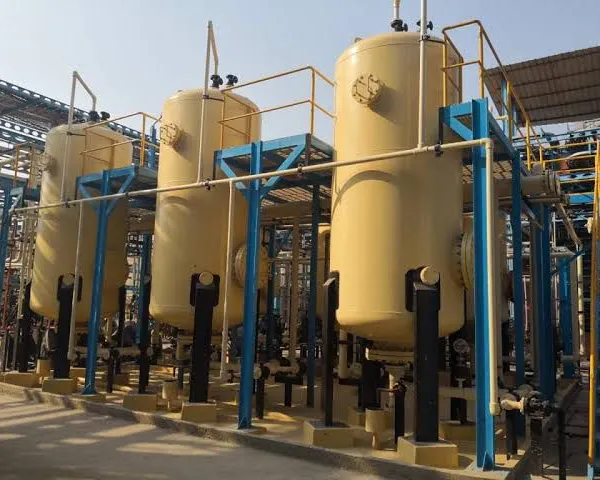 Read More
 -
Seawater Electrochlorination vs Chemical Dosing: A Cost and Safety Comparison for Cooling Water
September 3, 2026A desalination plant in the Gulf region was dosing bulk sodium hypochlorite into its cooling intake at a cost of $1,800 per truckl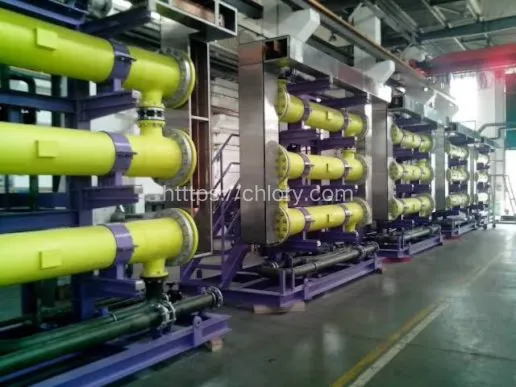 Read More
 -
Understanding Electrochlorination Technology: How Seawater Becomes a Disinfectant
September 2, 2026A coastal power plant in Southeast Asia discovered that a single season of heavy mussel growth inside its 1.6-meter cooling water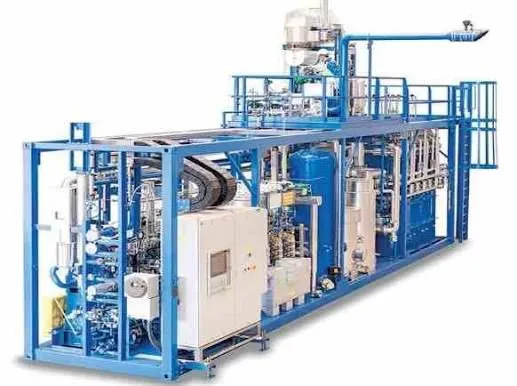 Read More

Contact Us
Recommended Products
-
 13% High Test Hypochlorite Machine for Heavy Duty DisinfectionUS$ 50000 - 300000MOQ: 1 Set
 -
9% On-Site Hypochlorite Generator for Bottled Water PlantsUS$ 50000 - 300000MOQ: 1 Set
-
14% High Purity Sodium Hypochlorite Plant for BleachingUS$ 50000 - 300000MOQ: 1 Combo
-
15% High Concentration Sodium Hypochlorite Generator for Water TreatmentUS$ 50000 - 300000MOQ: 1 Combo
-
15 Kg/h Seawater Electrolytic Antifouling System for RefineriesUS$ 50000 - 300000MOQ: 1 Set
-
0.1%-0.2% Electrochlorination Unit for Seawater Cooling AntifoulingUS$ 50000 - 300000MOQ: 1 Set
-
20 Kg/day Seawater Electrolysis Plant for Coastal Power PlantsUS$ 50000 - 300000MOQ: 1 Set
-
5 Kg/h Electrolytic Seawater System for Marine Ballast TreatmentUS$ 50000 - 300000MOQ: 1 Set
-
100 M³/h Electrolytic Seawater Antifouling System for LNG TerminalsUS$ 50000 - 300000MOQ: 1 Set
-
50 Ppm On-Site Sodium Hypochlorite Generator From SeawaterUS$ 50000 - 300000MOQ: 1 Set
-
Liquid Chlorine Equipment for Chlor-Alkali Production PlantUS$ 200000 - 2000000MOQ: 1 Set
-
Custom Chlor-Alkali Plant EPC Turnkey Solution for Integrated Chemical Manufacturing PlantUS$ 100000 - 2000000MOQ: 1 Set
-
99% High Purity Caustic Soda Flakes EPC Project for Fine Chemical & Metallurgical IndustryUS$ 100000 - 2000000MOQ: 1 Set
-
33% Industrial Hydrochloric Acid Production Equipment for Pickling & Wastewater TreatmentUS$ 100000 - 2000000MOQ: 1 Set
-
Industrial Liquid Chlorine Production & Storage Equipment for Chemical Synthesis & Water DisinfectionUS$ 100000 - 2000000MOQ: 1 Set
-
100kg/hour WPC80 Concentrated Whey Protein Powder Production Line Membrane Filtration Concentration EquipmentUS$ 50000 - 500000MOQ: 1 Set
-
Full-Automatic Beverage Processing Machinery Whole Production Line Membrane Clarification Membrane Filtration EquipmentUS$ 50000 - 500000MOQ: 1 Set
-
Instant Tea Whole Product Line Membrane Filtration, Concentration and Dehydration EquipmentUS$ 50000 - 500000MOQ: 1 Set
-
Goat Milk Sterilization and Concentration SystemUS$ 50000 - 500000MOQ: 1 Set
-
Sanitary Nanofiltration Membrane Dealcoholization System Low Alcohol Wine Beer Filtration EquipmentUS$ 50000 - 500000MOQ: 1 Set