
 Business License

Understanding Electrochlorination Technology: How Seawater Becomes a Disinfectant
A coastal power plant in Southeast Asia discovered that a single season of heavy mussel growth inside its 1.6-meter cooling water intake lines had reduced heat transfer efficiency by roughly 18%. The resulting capacity derating forced the plant to run two auxiliary boilers at extra fuel cost for 40 days, adding an estimated $260,000 to operating expenses. The corrective scraping operation, performed during a forced outage, cost another $90,000 in labor and downtime.
That scenario repeats across the region every year. Marine organisms — mussels, barnacles, and biofilm-forming bacteria — colonize any submerged surface within weeks. For coastal industries that draw raw seawater, the question is never whether biofouling will happen, but how to control it without creating bigger problems. Electrochlorination technology offers an answer that is elegant in principle and demanding in practice.
1. What Is an Electrochlorination System
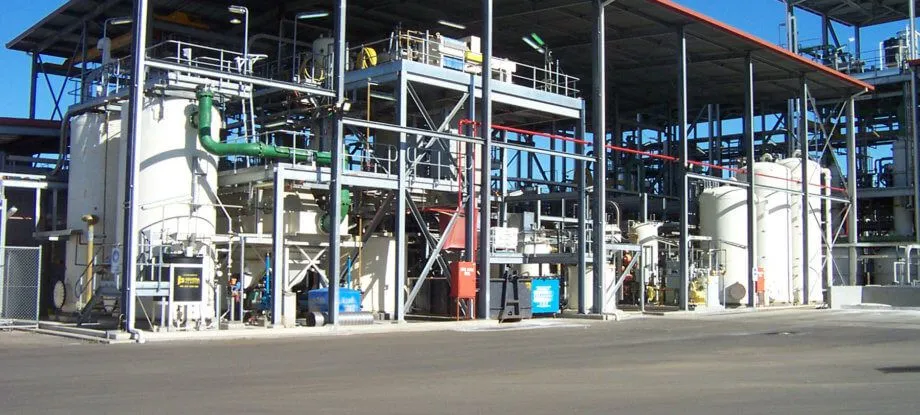
An electrochlorination system is an industrial plant that generates sodium hypochlorite (NaClO) on-site by electrolyzing seawater or brine, eliminating the need to transport and store hazardous chlorine chemicals. The process converts the chloride ions naturally present in seawater — roughly 19,000 to 20,500 mg/L — into a disinfectant that can be dosed directly into cooling water, potable water, or process streams.
The core idea is simple: instead of buying chlorine in cylinders, drums, or bulk tankers, a facility produces what it needs when it needs it. This is why electrochlorination has become the default choice for coastal power stations, offshore platforms, and industrial plants where seawater is abundant and chemical logistics are difficult.
2. The Electrochemistry Behind Seawater Electrolysis Chlorine Production
When a direct current passes through seawater between two electrodes, three reactions occur at once. At the anode, chloride ions give up electrons and form dissolved chlorine gas. At the cathode, water molecules accept electrons, producing hydrogen gas and hydroxide ions. The dissolved chlorine then reacts rapidly with the hydroxide ions to form hypochlorite — the active disinfecting species.
The overall result can be summarized simply: seawater plus electricity plus a few seconds of residence time yields a dilute sodium hypochlorite solution, typically 0.5% to 2.0% available chlorine. The reaction is not fully efficient, and the practical yield depends on current density, temperature, salinity, and cell design.
Operators often ask why the product is so dilute. The answer is thermodynamic: seawater contains only about 2% chloride by weight, so the chlor-alkali balance limits how much hypochlorite can accumulate before side reactions — mainly the formation of chlorate and oxygen — begin consuming the product. In our experience, keeping the concentration below roughly 1.5% preserves both efficiency and electrode life.
It also helps to think in terms of chlorine yield per pass. A single pass through the cell converts only a fraction of the incoming chloride, so the flow rate, not just the current, determines output. Doubling the current at the same flow roughly doubles chlorine production up to the mass-transfer limit, beyond which more energy simply generates heat and oxygen. This is why system sizing is a joint electrical and hydraulic calculation, and why experienced vendors ask for the seawater flow profile before quoting an electrolyzer.
3. Key Components of a Seawater Electrochlorination Plant
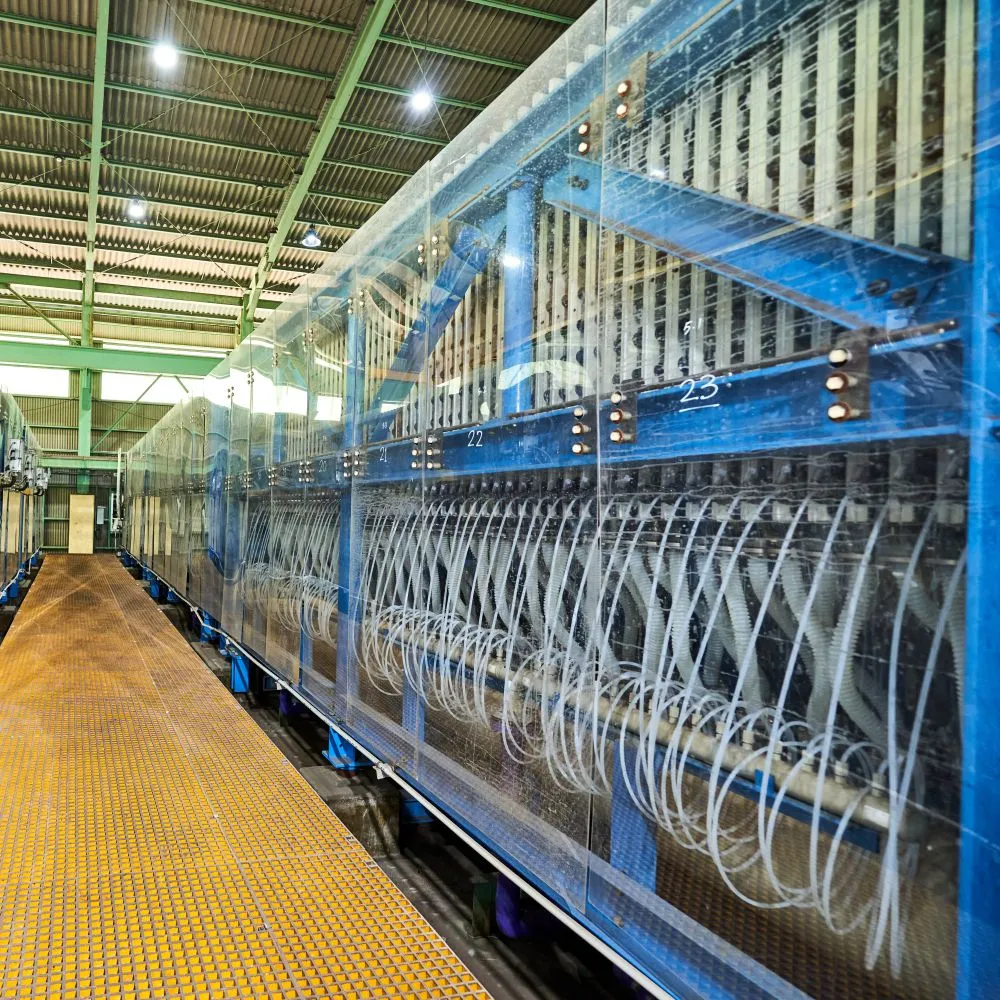
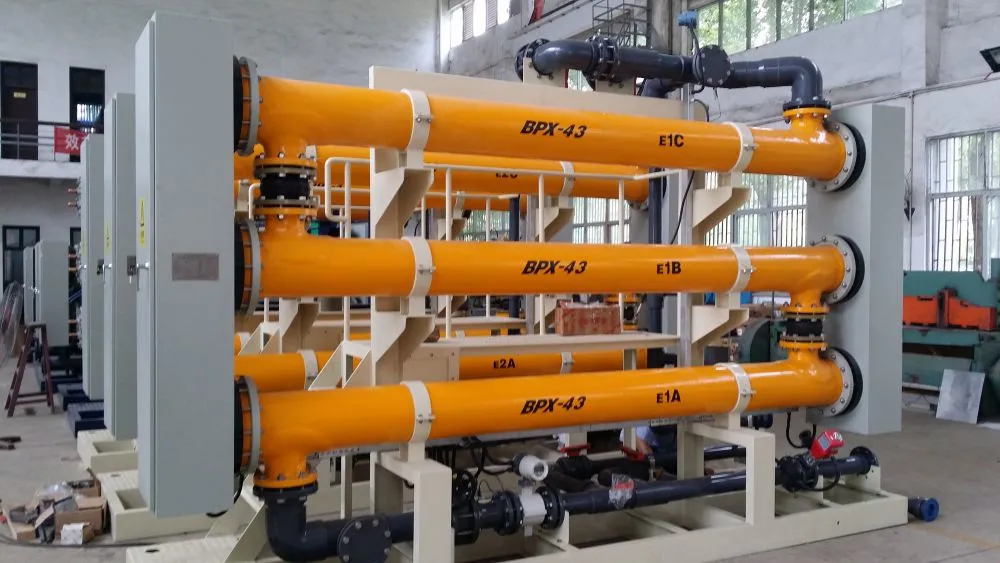
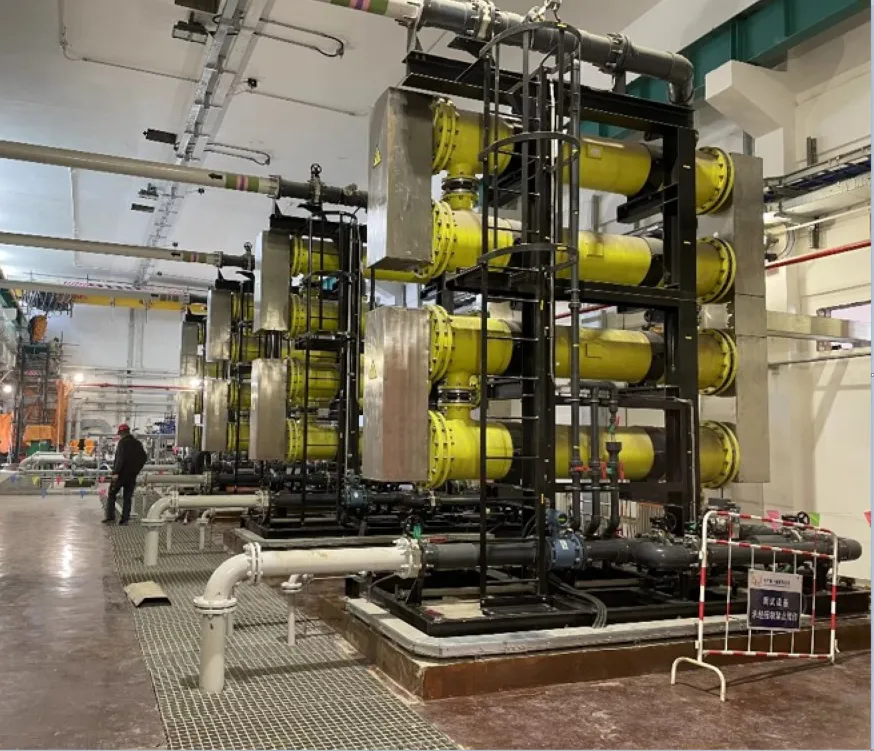
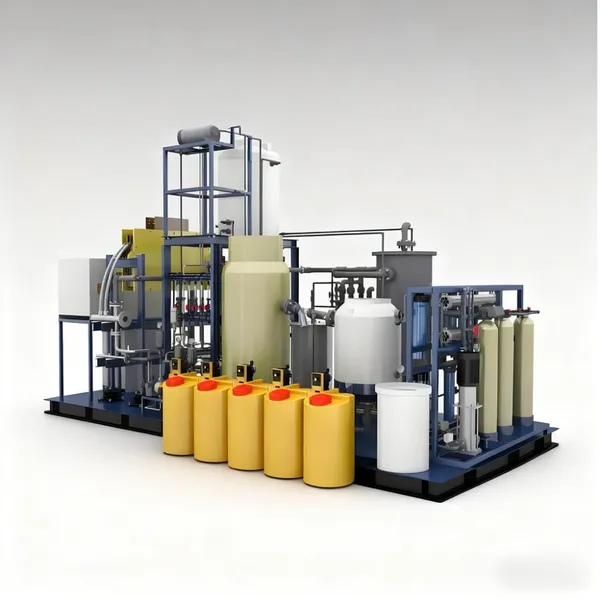
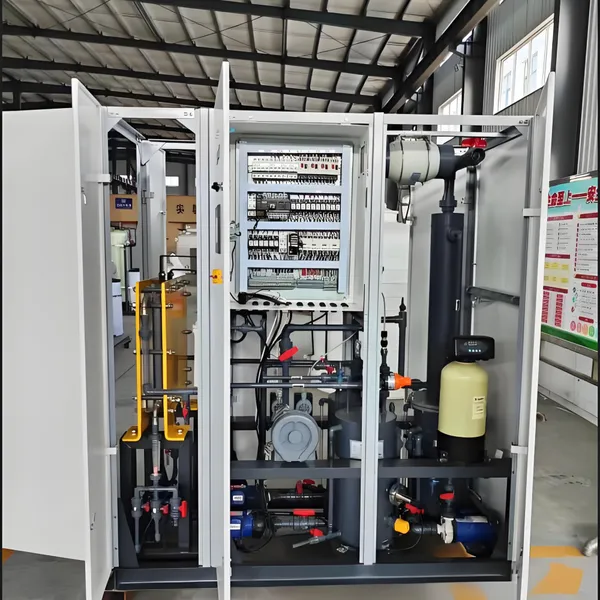
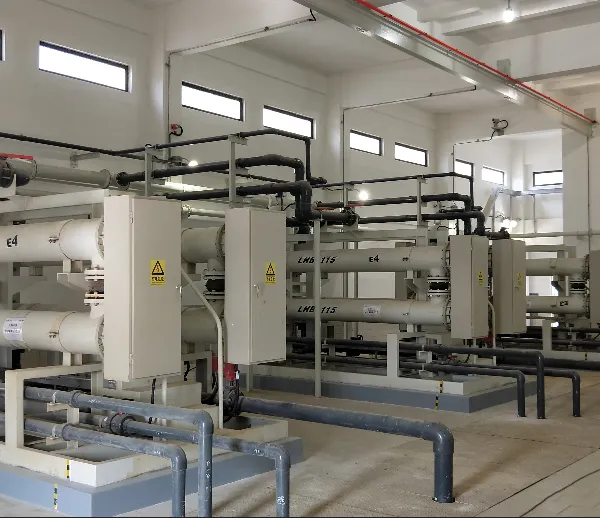
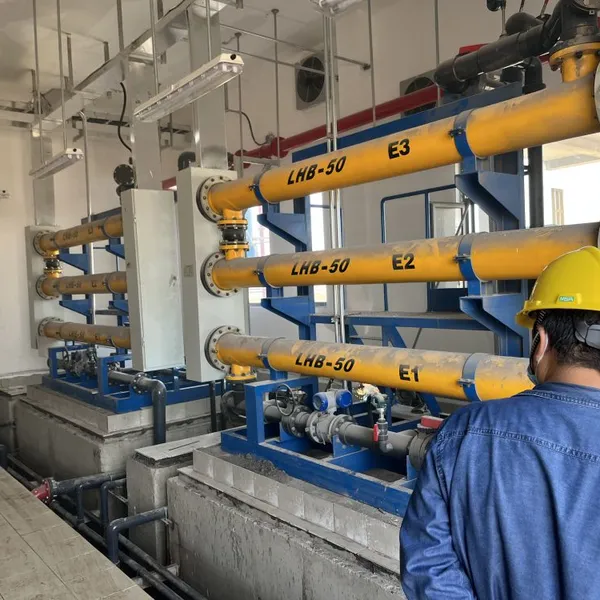
An electrochlorination system is more than a box of electrodes. A complete package typically includes seawater intake and filtration, a rectifier, one or more electrolyzer cells, a degassing unit for hydrogen, product storage, and dosing pumps. Each subsystem has a specific job, and the weakest link sets the reliability of the whole train.
| Subsystem | Function | Typical Specification |
|---|---|---|
| Intake & filtration | Remove sand, silt, and marine organisms before electrolysis | Filtration to 0.3–1.0 mm; self-cleaning strainers |
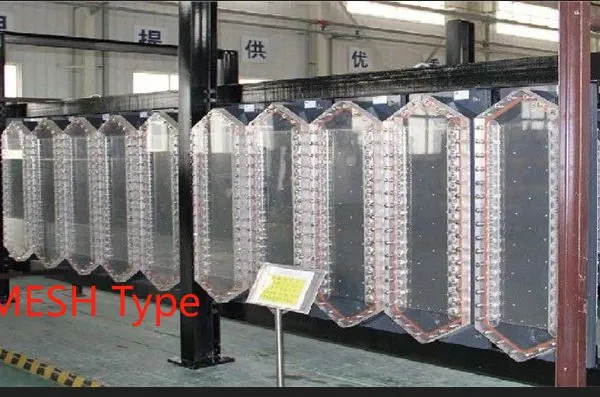
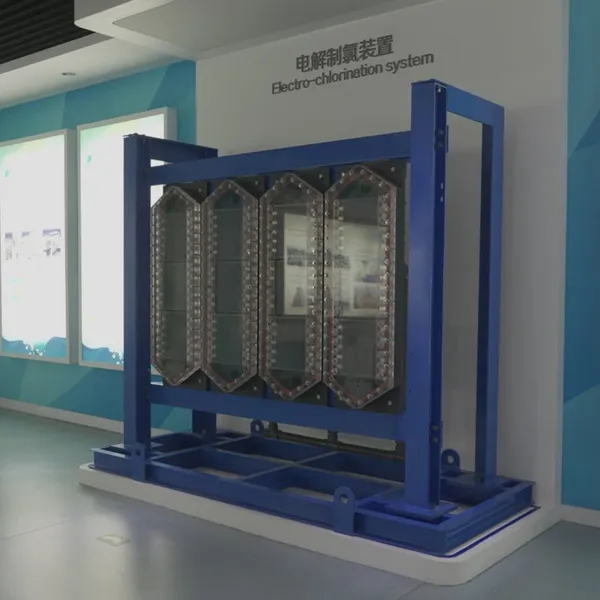
| Electrolyzer cell | Convert chloride to hypochlorite | MMO-coated titanium anodes; titanium or Hastelloy cathodes |
| Rectifier | Convert AC to regulated DC current | SCR or IGBT; current density 1,500–3,000 A/m² |
| Degassing tank | Separate and vent hydrogen safely | Forced-air dilution below 2% by volume |
| Product storage | Buffer between generation and dosing | HDPE tank sized for 12–48 hours of demand |
| Dosing and control | Inject hypochlorite and trim the dose | Metering pumps with residual chlorine feedback |
Tianjin Bluewav Technology Co.,ltd manufactures complete electrochlorination systems with these six subsystems integrated on a single skid, which shortens installation time and simplifies commissioning on remote sites.
4. Operating Parameters That Determine Performance
Three parameters dominate how well a seawater electrolysis chlorine unit performs: current density, flow rate through the cell, and water temperature. Raise the current density and you get more chlorine per square meter of electrode, but you also accelerate electrode wear and raise energy consumption. Lower the flow rate and residence time increases, allowing the reaction to proceed further — yet hydrogen accumulation and heating begin to hurt efficiency.
Typical operating windows used in the industry include a current density of 1,500 to 2,500 A/m² for seawater service, a cell temperature of 15°C to 30°C, and a seawater salinity of 28 to 35 parts per thousand. Within these windows, specific energy consumption runs roughly 3.5 to 5.0 kWh per kilogram of equivalent chlorine, and salt utilization efficiency reaches 80% to 90%.
Water quality matters more than most buyers expect. Suspended solids above 20 mg/L clog the cell and abrade coatings; hardness from calcium and magnesium forms scale on the cathode, which reduces efficiency by 15% to 25% if left untreated. Coastal sites therefore install filtration and periodic acid cleaning as standard practice.
A useful sizing rule of thumb for a once-through seawater cooling system is 2 to 5 kg of equivalent chlorine per million liters of cooling water flow, adjusted for temperature and season. Tropical waters with heavy mussel settlement sit at the high end of that range, while temperate systems with modest biological load can run near the low end. Working out this number before selecting the rectifier and cell bank prevents both under- and over-specification, two mistakes we see frequently in retrofit projects.
5. Why Coastal Industries Choose Seawater Electrolysis Chlorine
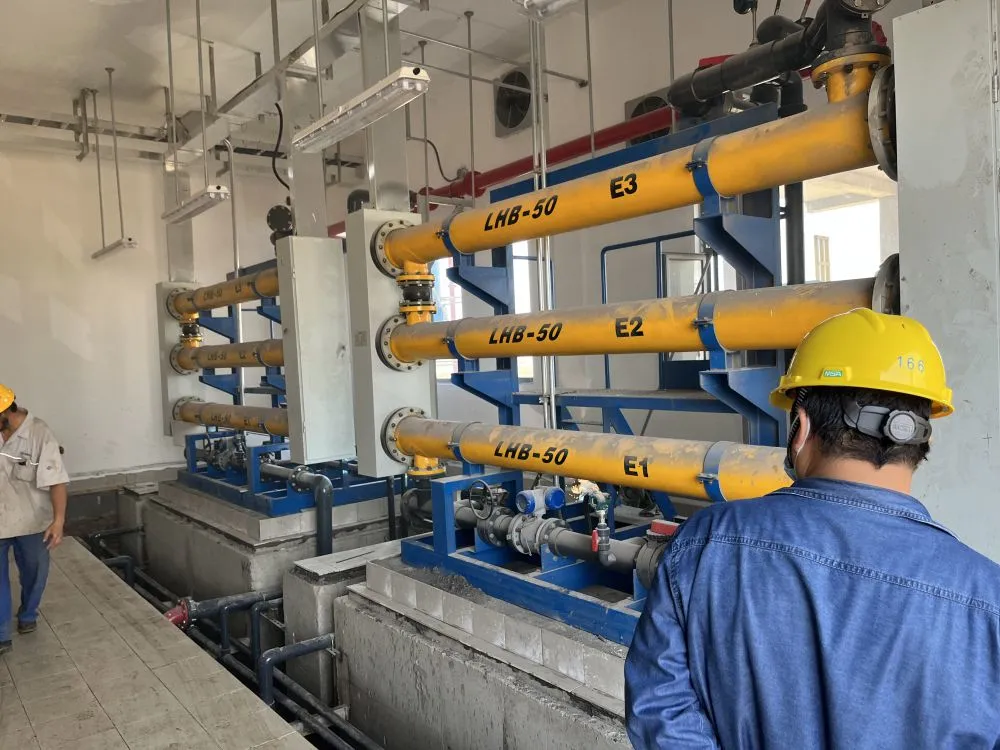
For facilities already sitting beside the sea, seawater offers a free and unlimited feedstock. No salt purchase, no brine preparation, and no chemical storage — the ocean is the warehouse. This is why nuclear and fossil power plants on coastlines, LNG terminals, and offshore platforms overwhelmingly favor seawater electrochlorination for cooling water biofouling control.
The alternative — shipping bulk sodium hypochlorite or chlorine gas to a coastal site — carries recurring logistics costs and regulatory exposure. A 1,000 MW power plant consuming 300 kg of equivalent chlorine per day would need roughly 2,400 liters of 12.5% commercial hypochlorite delivered every single day. Electrochlorination removes that daily dependency entirely.
There is also a resilience angle that operators increasingly value. On-site generation keeps the plant running through port strikes, storm seasons, and road closures that interrupt chemical deliveries. In several projects we have worked on, the deciding factor was not the cost spreadsheet but the certainty of supply. When the alternative is a shutdown, the capital cost of the electrochlorination package becomes an insurance premium, and a reasonable one at that.
6. Applications Where Electrochlorination Excels
Cooling water biofouling control is the dominant application, but the technology serves many roles. Coastal power plants dose hypochlorite at the intake to keep condenser tubes and heat exchangers free of mussels, barnacles, and slime. Offshore oil and gas platforms use it for cooling water, fire water systems, and water injection, where chemical resupply by boat or helicopter is both slow and expensive.
Municipal and industrial seawater desalination plants apply electrochlorination to control biological growth on membranes and in intake structures. Ships and ports use it for ballast water treatment, where the technology must meet the IMO Ballast Water Management Convention's D-2 discharge standards. Each application places different demands on dosing control, residual measurement, and system redundancy.
Dosing strategy differs by application. Continuous low-dose dosing at 0.1 to 0.5 mg/L residual suits steady-state protection of cooling circuits, while intermittent shock dosing at 1 to 3 mg/L for a defined period clears established growth. Many plants alternate the two, maintaining a low baseline and adding shock doses on a weekly or biweekly schedule. The control philosophy is usually settled during detailed design, but it shapes the size of the product storage tank and the range of the dosing pumps, so it deserves early attention in the project.
Bluewav has supplied electrochlorination packages for power plants, desalination projects, and offshore applications, and we have observed that application-specific engineering — not just hardware selection — determines long-term success.
7. Hydrogen Management: The Safety Detail That Cannot Be Skipped
Electrolysis produces hydrogen at the cathode, roughly 0.028 kg per kilogram of chlorine generated. Hydrogen is flammable across a wide concentration range, so the gas must be diluted below 2% by volume — half the lower explosive limit — before it can be vented. Modern systems use a forced-air degassing tank and continuous hydrogen monitoring with automatic shutdown interlocks.
In a properly designed system, hydrogen handling is routine. In a poorly designed one, it is the first thing inspectors flag. We recommend that buyers verify the hydrogen dilution blower is rated for the full chlorine output, not the average, and that the monitoring loop is tested during commissioning rather than assumed.
Ventilation design extends beyond the degassing tank. The electrolyzer room should maintain negative pressure relative to surrounding areas, and exhaust fans should be sized for the worst-case hydrogen release with margin. Gas detectors tied to the plant alarm system give operators early warning. None of this is exotic — it follows established electrochemical plant practice — but it is exactly the kind of detail that separates a field-tested package from a laboratory prototype.
8. Case Studies
A 600 MW combined-cycle power plant in the Philippines suffered repeated mussel fouling in its once-through cooling system, losing roughly 12 MW of net output during peak settlement months. Some time ago, the plant replaced its chlorination gas dosing with a seawater electrochlorination system supplied by Tianjin Bluewav Technology, sized for 180 kg/day of equivalent chlorine. After commissioning, condenser cleanliness factors stayed above 90% through two full settlement seasons. The plant reported a payback period of roughly 2.5 years based on recovered output and avoided chemical purchases.
An LNG receiving terminal in the Middle East installed a smaller 60 kg/day unit to protect its seawater cooling exchangers. In the first year of operation, the terminal logged zero unscheduled cleaning outages, compared with two the year before.
9. Cost and Energy Reality Check
Electrochlorination is not free energy. The electricity consumed by the rectifier and the pumps is a permanent operating cost, typically 3.5 to 5.0 kWh per kilogram of chlorine equivalent. At an industrial electricity price of $0.08 to $0.12 per kWh, the energy cost per kilogram of chlorine lands between $0.28 and $0.60, before adding depreciation, maintenance, and labor.
Against that, the avoided costs include delivered bulk hypochlorite — often $0.40 to $0.80 per liter at coastal sites — plus storage tank inspection, hazmat handling fees, and the administrative burden of chemical permits. For continuous, year-round demand above roughly 100 kg/day, the life-cycle comparison typically favors on-site generation, with payback periods commonly reported between 2 and 4 years.
10. Frequently Asked Questions
10.1 Is seawater electrolysis chlorine the same as household bleach?
Chemically, yes — both are sodium hypochlorite solutions. The differences are concentration and purity. Electrochlorination produces a dilute solution of roughly 0.5% to 2.0% available chlorine from filtered seawater, while household bleach is typically 3% to 6% and commercial products reach 12% to 15%.
The dilute on-site product has no transport hazard and no chlorate buildup from long storage, but it requires larger dosing volumes because the active content is lower. A plant dosing 1 mg/L residual into a 10,000 m³/h cooling flow will pump roughly 10,000 liters per day of 1% product, so storage and pump sizing must account for the dilution factor.
10.2 How long do the electrodes last?
Electrode life depends on current density, water quality, and operating hours. Mixed metal oxide (MMO) coated titanium anodes in seawater service typically last 5 to 8 years before coating depletion forces replacement. Running at higher current density shortens that window; keeping the cell clean and staying within the rated range extends it. Most suppliers, including Tianjin Bluewav Technology, quote an expected service life and offer anode replacement as a spare part.
A practical monitoring habit is to log cell voltage weekly — a gradual rise of 5% to 8% over the service life is normal, while a sudden jump of 15% or more signals localized coating failure and the need for inspection.
10.3 What happens to the byproducts?
Electrochlorination generates three byproducts: hydrogen, which is diluted and vented; chlorate, which forms slowly in the product tank and is controlled by limiting concentration and residence time; and a small amount of scale from seawater hardness, which is removed by periodic acid cleaning. Chlorate levels in the dosed water remain well within WHO drinking water guidelines when the system is operated as designed. Operators should still monitor chlorate periodically, because the formation rate accelerates if the product is held for many days at high concentration or elevated temperature. In continuous once-through dosing, residence time is short and chlorate accumulation is minimal.
10.4 Can electrochlorination work with brackish water?
Yes, but with reduced efficiency. The reaction rate depends on chloride concentration, so brackish water at 5 to 10 parts per thousand salinity produces less chlorine per unit of energy than full-strength seawater. Systems can be designed with higher current density or larger electrode area to compensate, at some cost in energy and electrode life. If salinity falls below roughly 3 parts per thousand, adding a small brine feed is the more practical route.
A site with variable salinity — for example, an estuary where freshwater inflows shift seasonally — should be designed for the lowest expected chloride level, otherwise output will fluctuate with the tide and the dosing control must compensate.
Recently Posted
-
Power Plant Cooling Water Biofouling Control: How Electrochlorination Replaces Chlorine Gas
September 4, 2026An aging coal-fired plant on the Atlantic coast of South America had relied on chlorine gas dosing for cooling water treatment sin Read More
 -
Advances in Electrode Coating Technology for Chlorine Generation: Longer Life, Lower Overpotential
September 4, 2026An electrochlorination plant in the Middle East was drawing 4.9 kWh per kilogram of chlorine when its cells were new. Five years l Read More
 -
How to Select a Sodium Hypochlorite Generator: 7 Key Parameters Every Buyer Should Check
September 3, 2026A municipal water utility bought a sodium hypochlorite generator based on chlorine output alone, without examining the feed water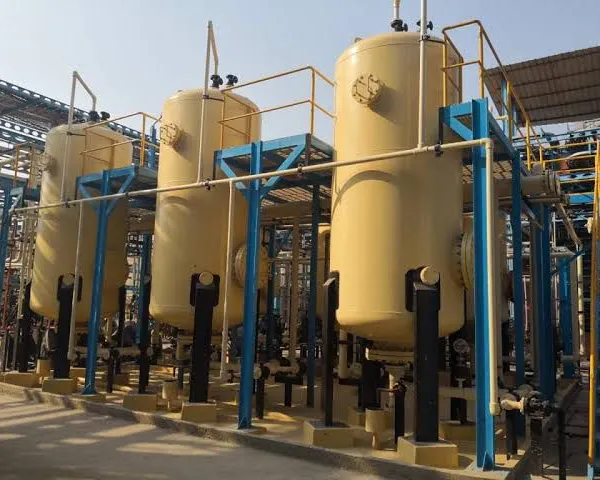 Read More
 -
Seawater Electrochlorination vs Chemical Dosing: A Cost and Safety Comparison for Cooling Water
September 3, 2026A desalination plant in the Gulf region was dosing bulk sodium hypochlorite into its cooling intake at a cost of $1,800 per truckl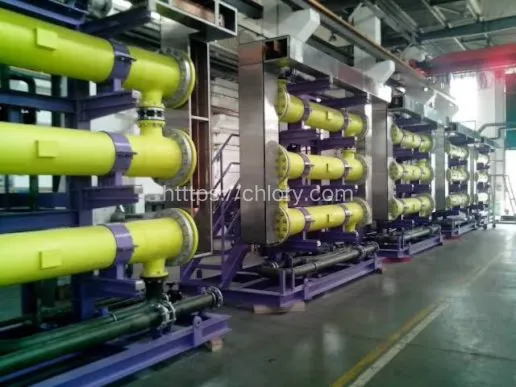 Read More

Contact Us
Recommended Products
-
 13% High Test Hypochlorite Machine for Heavy Duty DisinfectionUS$ 50000 - 300000MOQ: 1 Set
 -
9% On-Site Hypochlorite Generator for Bottled Water PlantsUS$ 50000 - 300000MOQ: 1 Set
-
14% High Purity Sodium Hypochlorite Plant for BleachingUS$ 50000 - 300000MOQ: 1 Combo
-
15% High Concentration Sodium Hypochlorite Generator for Water TreatmentUS$ 50000 - 300000MOQ: 1 Combo
-
15 Kg/h Seawater Electrolytic Antifouling System for RefineriesUS$ 50000 - 300000MOQ: 1 Set
-
0.1%-0.2% Electrochlorination Unit for Seawater Cooling AntifoulingUS$ 50000 - 300000MOQ: 1 Set
-
20 Kg/day Seawater Electrolysis Plant for Coastal Power PlantsUS$ 50000 - 300000MOQ: 1 Set
-
5 Kg/h Electrolytic Seawater System for Marine Ballast TreatmentUS$ 50000 - 300000MOQ: 1 Set
-
100 M³/h Electrolytic Seawater Antifouling System for LNG TerminalsUS$ 50000 - 300000MOQ: 1 Set
-
50 Ppm On-Site Sodium Hypochlorite Generator From SeawaterUS$ 50000 - 300000MOQ: 1 Set
-
Liquid Chlorine Equipment for Chlor-Alkali Production PlantUS$ 200000 - 2000000MOQ: 1 Set
-
Custom Chlor-Alkali Plant EPC Turnkey Solution for Integrated Chemical Manufacturing PlantUS$ 100000 - 2000000MOQ: 1 Set
-
99% High Purity Caustic Soda Flakes EPC Project for Fine Chemical & Metallurgical IndustryUS$ 100000 - 2000000MOQ: 1 Set
-
33% Industrial Hydrochloric Acid Production Equipment for Pickling & Wastewater TreatmentUS$ 100000 - 2000000MOQ: 1 Set
-
Industrial Liquid Chlorine Production & Storage Equipment for Chemical Synthesis & Water DisinfectionUS$ 100000 - 2000000MOQ: 1 Set
-
100kg/hour WPC80 Concentrated Whey Protein Powder Production Line Membrane Filtration Concentration EquipmentUS$ 50000 - 500000MOQ: 1 Set
-
Full-Automatic Beverage Processing Machinery Whole Production Line Membrane Clarification Membrane Filtration EquipmentUS$ 50000 - 500000MOQ: 1 Set
-
Instant Tea Whole Product Line Membrane Filtration, Concentration and Dehydration EquipmentUS$ 50000 - 500000MOQ: 1 Set
-
Goat Milk Sterilization and Concentration SystemUS$ 50000 - 500000MOQ: 1 Set
-
Sanitary Nanofiltration Membrane Dealcoholization System Low Alcohol Wine Beer Filtration EquipmentUS$ 50000 - 500000MOQ: 1 Set